

Aero + Predictive Allocation FAQ
Aero
What is Aero?
Aero will be the unified liquidity layer for all of Ethereum, combining Aerodrome and Velodrome into a single protocol built on MetaDEX03, the next-generation DEX operating system from Dromos Labs.
What is the relationship between Aero, Aerodrome, and Velodrome?
Aerodrome and Velodrome are separate protocols built on MetaDEX02. Aero will bring them together under one token, one governance system, and one economic framework.
Will Aero be a new exchange?
Yes. Aero will be a new protocol, the result of an upcoming merger between Aerodrome and Velodrome.
When will Aero launch?
Aero is currently set to launch in September 2026, following the completion of formal audits and a three-week public audit contest. A final launch target will be shared post-audit. See Aero is on the Horizon for the full timeline.
Tokens and Terminology
Will Aero have its own token?
Yes. Its ticker will be AERO. All existing AERO and VELO tokens will need to be upgraded to the new token.
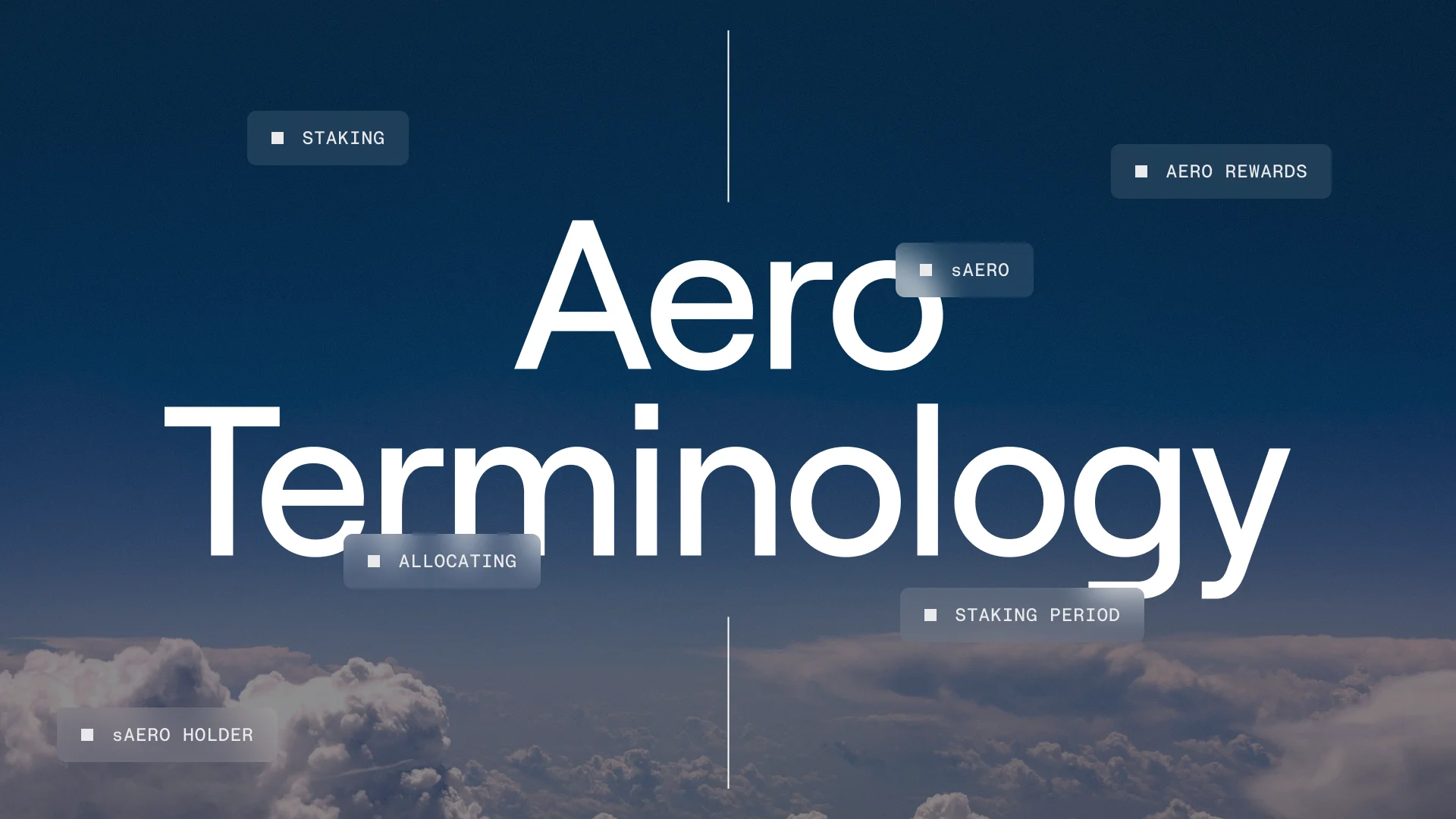
Why am I seeing new words, like “staking” and “allocating”?
With the launch of Aero, the internal terminology of the system will be updated. The goal is to make the language more accessible to a broader audience and retire language with inaccurate associations or that no longer reflects how the system works. The two biggest changes: Aero uses “staking” where Aerodrome used “locking,” and “allocating” where Aerodrome used “voting.”
Will the mechanics or experience of staking be different than locking/vote-escrowing?
No. The difference is in terminology only. Each stake will have a set term, determined by the staker at the time of staking. You will not be able to “unstake” before that term is up.
Can sAERO positions be traded or transferred?
Yes. sAERO positions can be traded and transferred. Currently, there is no plan to make it possible for holders to simply split sAERO positions.
What is the new terminology and what does each term mean?
For more detail, see New Terminology for a New Era.
Predictive Allocation
What is Predictive Allocation?
Predictive Allocation is a new onchain primitive developed by Dromos Labs: a decentralized mechanism for the concurrent, continuous, and cross-chain allocation of rewards and distribution of revenue. It will power Aero, replacing Aerodrome and Velodrome’s weekly voting system with a more real-time, market-driven process.
How will it work?
Instead of token operators voting once weekly to direct the following week’s rewards, they will allocate AERO rewards that stream to pools in real time. In return, they earn exchange revenue as it accrues live. Both AERO rewards and exchange revenue will stream concurrently and continuously.
Why change from the current system?
While Aerodrome and Velodrome’s current economic system is more efficient and performant than self-organizing liquidity marketplaces, operating on a weekly schedule creates two areas for further optimization:
- Efficiency: Because voters currently earn historical swap fee revenue while directing the following week’s AERO rewards, AERO can stream to pools that are no longer productive or valuable to the system. This is because voters seeking to maximize returns allocate to pools that have been previously productive, and they may not be the same pools that will be productive in the future.
- Opportunity cost: Because voting happens once weekly, the current system can be slow to respond to emerging pools and tokens, which must wait for a new vote before they can begin receiving emissions.
How does Predictive Allocation optimize these two areas?
Real-time revenue distribution combined with more frequent opportunities for reallocation means significantly less AERO streaming to unproductive pools. And because allocations can be shifted throughout the week, a pool that starts generating value can begin receiving AERO rewards much sooner than under the current system.
Why is it called “Predictive” Allocation?
A switch to real-time distribution means the allocation of AERO rewards will no longer be based on historical data but on predictions about where the market is moving next. Because exchange revenue accruing to a pool is only earned by token operators actively allocating to it, an early bet can earn more as operators compete to predict where liquidity will be most productive in the future. Consequently, the liquidity formed by these market forces will be built in anticipation of demand.
Will Aero have Gauge Caps, and what are they?
Yes. Gauge Caps will help prevent over-allocation to pools. They are designed to prevent AERO rewards from going to a pool unless a set level of fees actually materialize. The cap for each pool will be able to be set independently, ensuring maximum flexibility and competitiveness.
How often will people be able to shift their allocations?
At launch, the current plan is for operators to wait a minimum of 48 hours before being able to change their allocations, and to reduce that window over time. The 48hr window will be specific to each sAERO position.
If I don’t actively reallocate, does my existing allocation persist?
Yes.
What if the new system sounds too complicated?
Token operators who don’t want to actively manage allocations can still benefit from their sAERO by allocating to consistently productive pools. Aero will also launch with Autopilot: a configurable, automated allocation manager.
What is Autopilot?
Autopilot is the name of all automation features on Aero. For LPs, it will offer automated liquidity management for deposits in Slipstream pools. For stakers, it will offer simple configuration options to automate the allocation process. In addition to being able to compound earned revenue back into a position, Autopilot will offer new options including converting rewards directly to USDC.
Is Autopilot a rebrand of Relay?
Yes, it combines what is now Relay with ALM, and adds additional features and options.
What is a Production Market?
Any market where participants compete to allocate a shared economic resource, seeking to maximize the productivity of their own allocations. Each allocation directly funds economic activity, which means the prediction and the investment are the same act. Participants earn based on how productive that activity turns out to be, which means accurate allocation is rewarded and inaccurate allocation is not. The more participants compete, the more efficiently the shared resource is directed toward its highest-value use. This is a new category of system coined in the context of Predictive Allocation. Aero will be the first exchange featuring Production Markets.
How will Predictive Allocation impact projects that want to incentivize liquidity?
Projects will be able to flexibly stream incentives, either to stakers allocating rewards or to LPs. This solves a key problem from the epoch system, where voters received tokens in bulk at a single point in time.
Emissions and the AERO Fed
Will there be any element of community voting related to the emissions rate?
With Gauge Caps, Predictive Allocation, and the possibility of integrating AI tooling and a rules-based architecture into AERO Fed decision-making, the economics of the forthcoming Aero will be optimized for protocol sustainability. As a result, voter participation may not be required or activated.
Will sAERO include a rebase?
No. Rebase is going away.
New Revenue Streams: The REV Engine
What new revenue streams will Aero launch with?
Aero is set to launch with two new sources of revenue:
- Internal MEV Auctions
- Metaswaps (Bridge + Aggregator Fees)
Other near-term planned sources include fee revenue from a veNFT marketplace, auto-compounder, and Autopilot.
Who benefits from these new revenue streams?
Fees captured as exchange revenue will benefit sAERO holders, either through distribution or another mechanism. Some fees, e.g. MEV auction fees from LPs earning fees, will go directly to LPs, reducing the need for AERO Rewards.
Migration
Will I need to do something with my current tokens?
Yes. All AERO, veAERO, VELO, and veVELO will need to be upgraded to the new AERO and sAERO tokens.
Who receives the initial AERO supply at launch?
100% of the initial AERO supply goes to the existing Aerodrome and Velodrome communities.
Will veAERO NFT IDs remain the same after migration, or will new IDs be minted?
New token and NFT IDs will be minted. All veAERO and veVELO positions must be withdrawn and any pending rewards must be claimed from any contracts they are housed in before migrating.
Will centralized exchanges handle the upgrade automatically, or do I need to withdraw to a wallet first?
The team is actively working with CEXs to support the migration of liquid tokens. More details will be provided closer to launch.
What will happen to the old Aerodrome and Velodrome protocols after Aero launches?
The front ends of both protocols will be deprecated at a later date. Contracts are immutable and will continue to exist onchain, but gauges and factories will be retired.